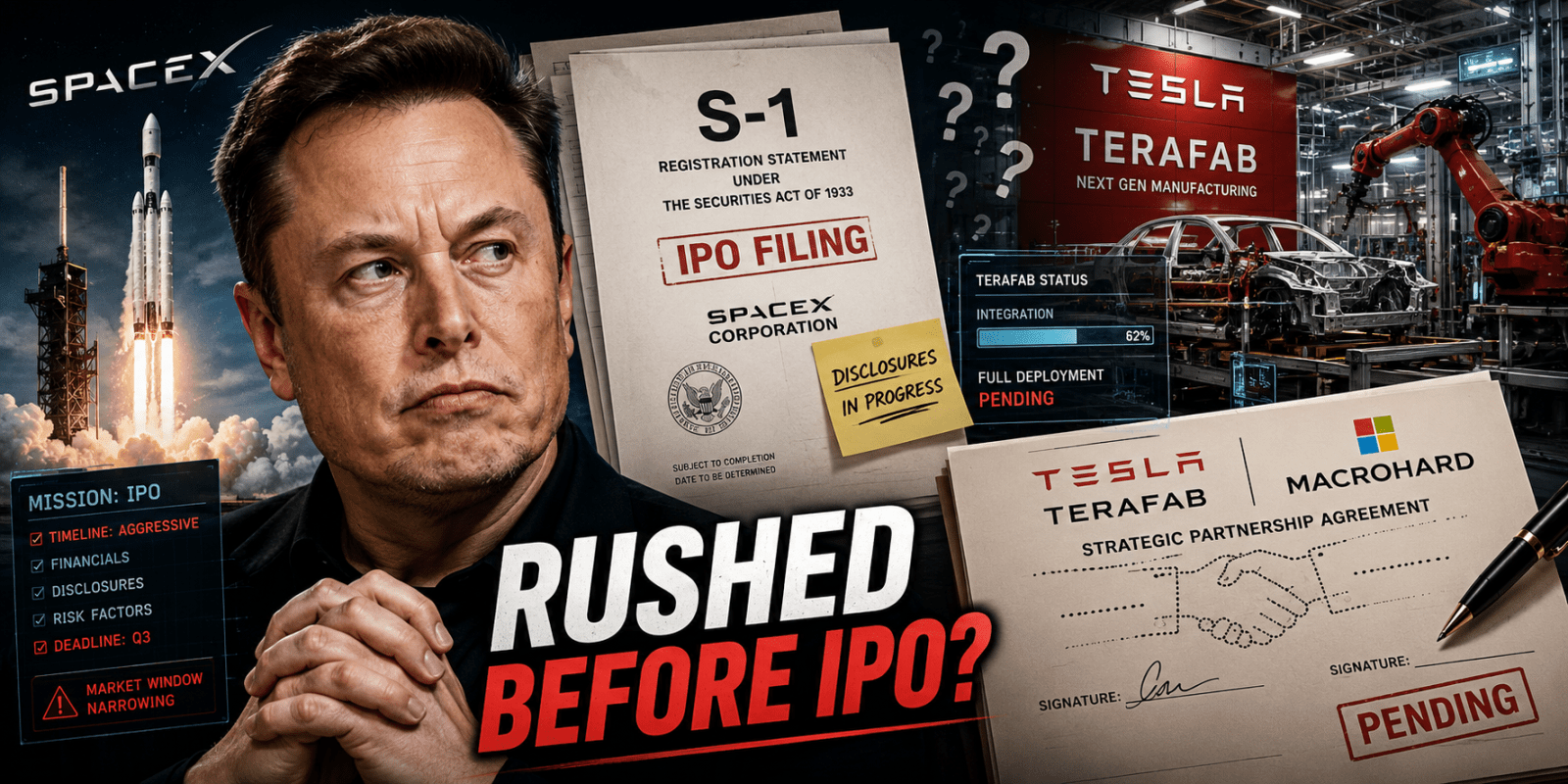
The tech world has just been rocked to its very core. SpaceX has officially filed its highly anticipated S-1 registration statement with the Securities and Exchange Commission (SEC) ahead of what is expected to be a blockbuster initial public offering (IPO). While retail investors and Wall Street analysts were preparing to celebrate the financial event of the decade, a terrifying reality check was buried deep within the massive 308-page document. This revelation threatens to completely derail the massive hype train engineered by billionaire Elon Musk regarding the intimate collaborations between Tesla (TSLA) and SpaceX.
The S-1 Bombshell: Inside the SpaceX IPO Filing
For months, Elon Musk has teased a glorious, highly integrated future where his various corporate empires work hand-in-hand. Tesla investors have been led to believe that joint ventures between the EV giant and the aerospace pioneer would yield unprecedented technological breakthroughs. However, the legal language contained in SpaceX’s official SEC filing tells a radically different story. According to the document, the highly publicized joint projects known as Terafab and Macrohard are far from being the revolutionary, done-deal partnerships they were portrayed to be.
In fact, the filing explicitly states that both projects are in their ‘very early stages’ of development. Shockingly, there are currently no finalized financial terms, no legally established intellectual property (IP) rights, and absolutely no binding commitments between the two companies. This means that despite the endless hype and social media posts, the entire foundation of the Tesla-SpaceX synergy is built on nothing more than hopes, handshakes, and unformed ideas. Analysts are already warning that this could cause a massive trust crisis among Tesla shareholders who priced these collaborations into the stock’s astronomical valuation.
What Are Terafab and Macrohard, and Why Do They Matter?
To understand the gravity of this deception, one must understand what Terafab and Macrohard were supposed to represent. Elon Musk has spent the last year pitching these concepts as the ultimate merger of heavy manufacturing and advanced artificial intelligence. Here is a breakdown of what investors thought they were getting:
- Terafab: A next-generation manufacturing facility leveraging SpaceX’s advanced metallurgy and rocket-grade structural engineering to help Tesla produce hyper-durable electric vehicles at a fraction of the current cost.
- Macrohard: A joint software initiative combining Tesla’s Full Self-Driving neural networks with SpaceX’s Starlink satellite constellation and Dojo supercomputer clusters to create an unbreakable global AI network.
These initiatives were positioned as the ultimate competitive advantages that would keep Tesla years ahead of legacy automakers and tech rivals alike. Instead, the S-1 filing reveals that these concepts are virtually empty shells with no legal framework to protect Tesla’s interests or guarantee that any technology will ever be shared.
The Legal Truth: No Binding Commitments or IP Rights
Why did SpaceX wait until its S-1 filing to reveal this? The answer is simple: federal securities laws. While executives can get away with vague promises and forward-looking statements on social media or during relaxed earnings calls, lying on an SEC registration statement carries severe criminal and civil penalties. SpaceX’s legal team had no choice but to lay out the cold, hard truth to potential IPO investors, even if it meant exposing the fragility of the Tesla alliance.
The lack of IP rights is particularly alarming for Tesla bulls. If SpaceX and Tesla are co-developing technology without a binding contract, who actually owns the resulting innovations? Historically, Musk has shifted resources and talent between his companies with fluid boundaries, but once SpaceX becomes a publicly traded entity with its own fiduciary duties to a new class of shareholders, this loose arrangement will become a legal minefield. According to a detailed report on Electrek, the lack of formalized agreements means that any collaborative value currently attributed to Tesla could evaporate overnight if SpaceX’s independent board decides to prioritize its own profits.
This S-1 filing serves as a stark warning to anyone investing blindly in the Musk ecosystem. The lines between visionary leadership and misleading hype are thinner than ever, and as SpaceX prepares to go public, the era of unchecked cross-company handshakes is officially over. Investors must now ask themselves: how much of the Tesla-SpaceX synergy was real, and how much was just a brilliant illusion designed to keep stock prices flying high?