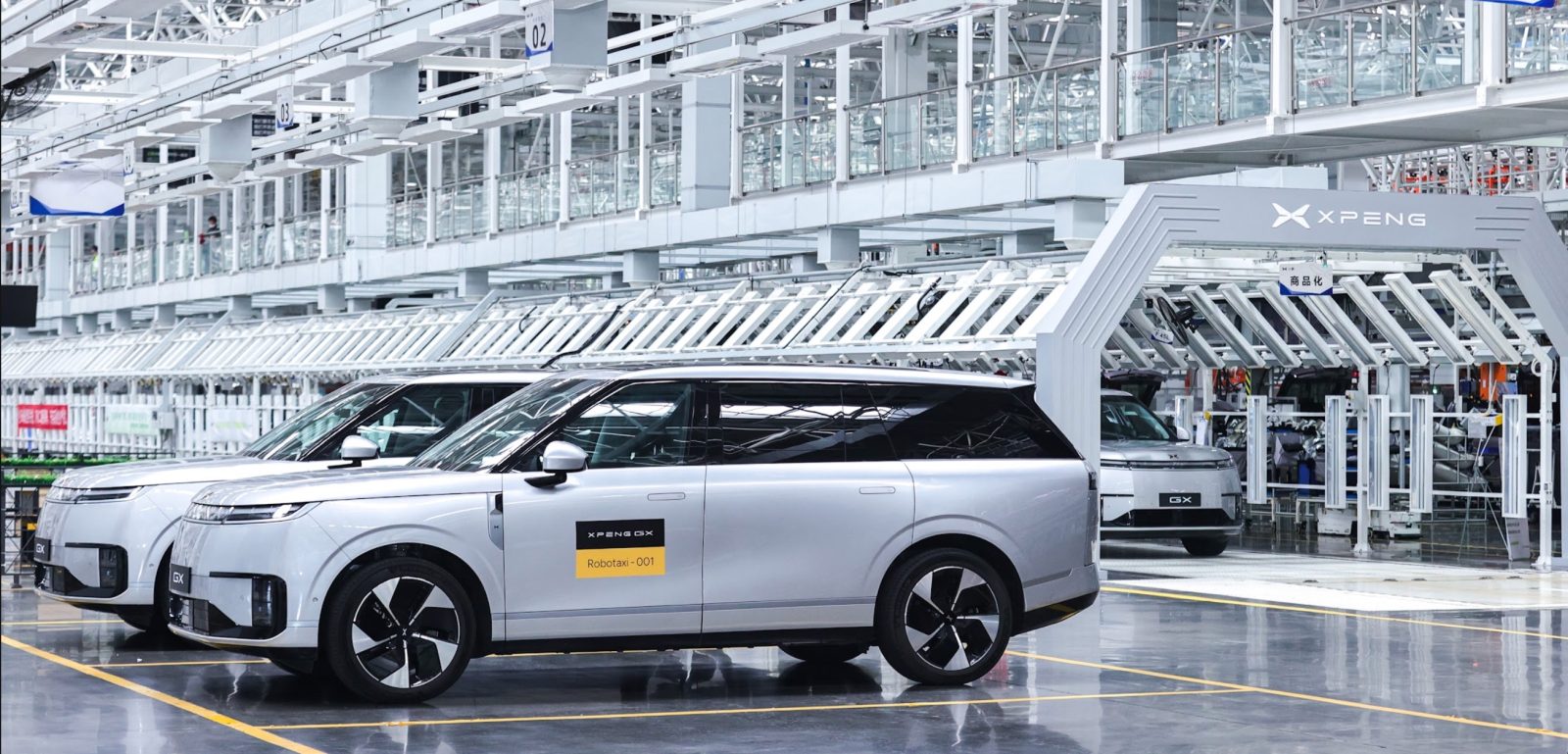
A massive seismic shift has just rocked the global electric vehicle and autonomous driving industries. In a stunning announcement that has left competitors scrambling, Chinese EV powerhouse XPeng has officially rolled its very first mass-produced robotaxi off the assembly line in Guangzhou. This monumental milestone does not just mark the birth of a new vehicle; it represents a historical turning point where science fiction officially becomes reality. XPeng has formally secured its crown as the first automaker in China to achieve true mass production of a robotaxi built entirely through full-stack, in-house development.
For years, tech giants and traditional legacy automakers have promised a future dominated by self-driving fleets. Yet, most have remained trapped in the endless loop of pilot programs, concept designs, and localized testing. XPeng has shattered this bottleneck, proving that they possess the manufacturing prowess and technological maturity to scale autonomous driving to the masses immediately.
The Death of LiDAR: XPeng’s Trillion-Dollar Gamble
Perhaps the most shocking revelation of XPeng’s brand-new GX Robotaxi is what is missing from its sleek chassis. For nearly a decade, the autonomous vehicle industry has insisted that LiDAR (Light Detection and Ranging) technology was an absolute necessity for safe L4 self-driving capabilities. Industry experts argued that relying solely on cameras and radar was a recipe for disaster. XPeng has completely flipped this narrative on its head by delivering an L4-standard vehicle that uses absolutely zero LiDAR sensors.
This bold move places XPeng directly in alignment with vision-only philosophies, yet they have supercharged their approach with unmatched computational hardware. By stripping away expensive LiDAR systems, XPeng has cracked the code on cost-efficiency, allowing them to mass-produce these autonomous marvels at a fraction of the cost of their competitors. This massive price reduction could trigger a brutal price war in the ride-hailing sector, potentially driving legacy taxi networks into extinction overnight.
How Turing AI Chips Redefine L4 Autonomy
To pull off a vision-only system of this magnitude, XPeng had to build a digital brain unlike anything the world has ever seen. The newly minted robotaxi is powered by four of XPeng’s proprietary, self-developed Turing AI chips. Together, this terrifyingly powerful chip array delivers an astonishing 3,000 TOPS (Trillion Operations Per Second) of computing power. To put that into perspective, this processing speed allows the vehicle to analyze millions of complex urban variables, predict pedestrian movements, and react to hazard conditions in a fraction of a millisecond.
By keeping development 100% in-house, XPeng has avoided the supply chain bottlenecks that plague other automakers who rely on third-party silicon. Every single line of code, sensor input, and hardware interface has been vertically integrated. This level of synchronization ensures that the vehicle can handle the chaotic, unpredictable nature of metropolitan traffic with unparalleled ease, setting a new benchmark for passenger safety and ride comfort.
The Looming Transportation Revolution: Are Human Drivers Finished?
The successful mass production of the XPeng robotaxi signals a massive disruption for the global gig economy. With driverless fleets poised to deploy on a massive scale, traditional ride-hailing giants and local taxi drivers face an unprecedented existential threat. A robotaxi does not require sleep, does not demand benefits, and operates with a level of mathematical precision that human drivers simply cannot replicate. Guangzhou is only the starting point; the global implications of this rollout are staggering.
According to an in-depth report by Electrek, this monumental achievement cements XPeng’s technological dominance in the highly competitive Asian market. As mass production ramps up, we can expect to see these futuristic vehicles invading major city streets sooner than anyone anticipated. The autonomous vehicle revolution is no longer a distant dream of the 2030s—it is happening right now, and XPeng is leading the charge.
- In-house Innovation: Powered by 4 custom Turing AI chips.
- Unmatched Power: Delivering over 3,000 TOPS of computing performance.
- Cost-Efficient: Vision-based system that entirely eliminates expensive LiDAR.
- L4 Certified: Engineered specifically for fully driverless urban operations.
Only time will tell how western competitors like Tesla and Waymo will respond to this massive escalation. One thing is certain: the race to dominate the driverless future has just entered its most volatile, exciting, and cutthroat era yet.