The Texas Takeover: Tesla Robotaxi Hits Dallas and Houston
In a move that has sent shockwaves through the automotive and ride-sharing industries, Tesla has officially announced the expansion of its revolutionary Robotaxi service into two of Texas’s most iconic hubs: Dallas and Houston. This monumental rollout marks the first time Elon Musk’s autonomous fleet has ventured beyond the initial testing grounds of Austin and San Francisco, signaling a massive leap forward in the company’s quest for global transport dominance. While the announcement has been met with viral excitement, the initial launch strategy suggests a calculated, surgical approach to urban integration.
The deployment of these driverless vehicles represents more than just a technological milestone; it is a direct challenge to traditional taxi services and modern ride-hailing giants like Uber and Lyft. By utilizing the proprietary ‘Full Self-Driving’ (FSD) software and a fleet of purpose-built autonomous vehicles, Tesla aims to slash transport costs while increasing safety. For residents of the Lone Star State, the sight of a steering-wheel-less vehicle navigating busy downtown corridors is no longer a futuristic dream—it is a current reality. However, as with all things Tesla, the devil is in the details of the geofence.
The Geofence Reality Check: Where Can You Actually Ride?
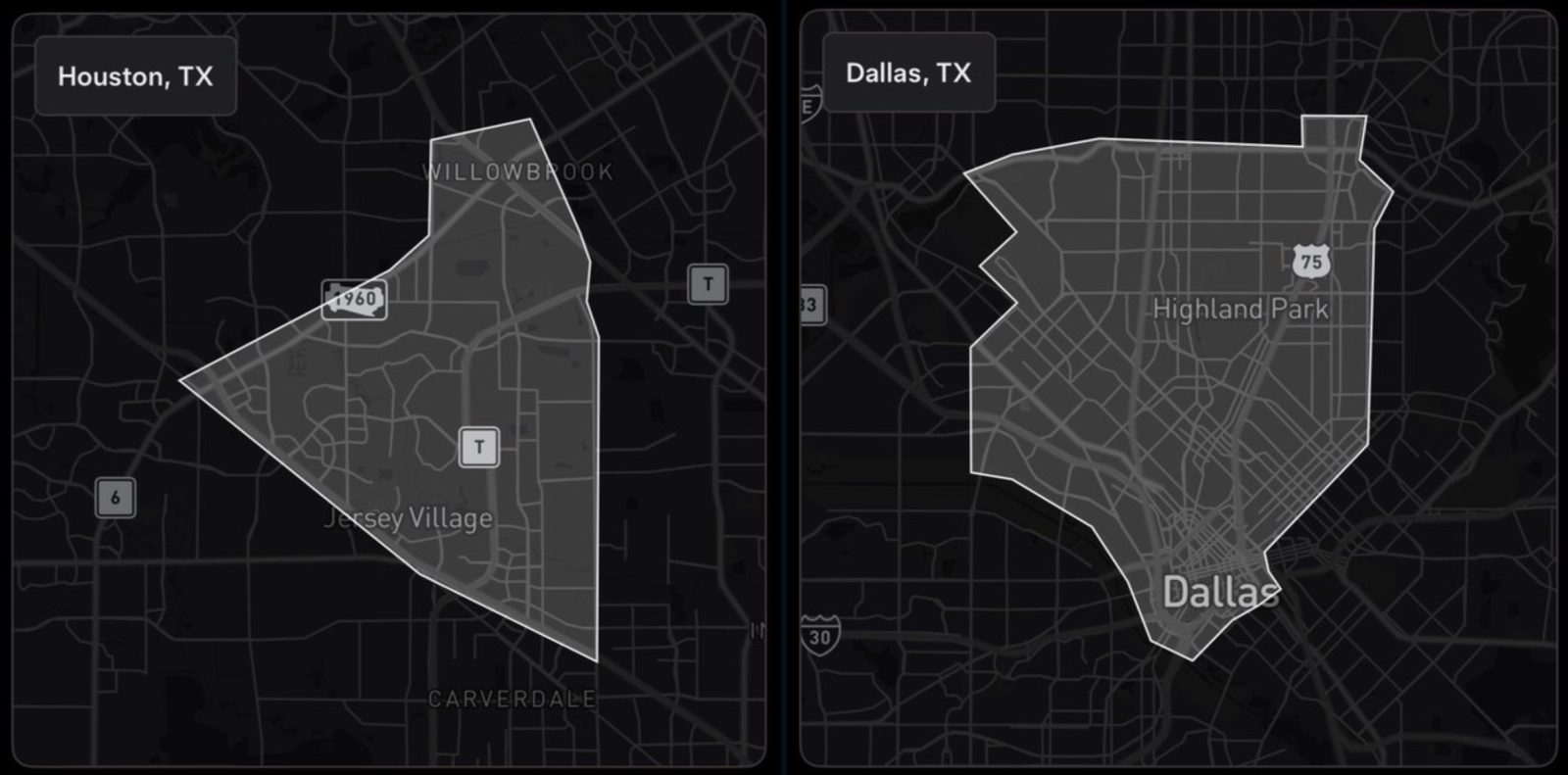
Despite the headline-grabbing news, the current service areas in Houston and Dallas are notably compact. According to early user analysis and maps released by Tesla, the Houston geofence covers approximately 25 square miles. This initial slice is likely designed to test the vehicles in high-density urban environments where traffic patterns are predictable yet challenging enough to refine the AI’s decision-making capabilities. In Dallas, the zone appears to center around the affluent Highland Park area, a strategic choice that likely targets high-income early adopters who are already integrated into the Tesla ecosystem.
To put these numbers into perspective, industry analysts often point to Tesla’s expansion history in Austin. The Austin geofence, which started at a similar 20-square-mile footprint, took nearly an entire year of data collection and software patches to reach its current size of 245 square miles. This ‘start small, scale fast’ philosophy is a hallmark of Tesla’s engineering culture. By limiting the operational domain, Tesla can ensure that its neural networks are perfectly mapped to every pothole, traffic light, and pedestrian crossing in the target zone before expanding into the chaotic outskirts of the greater metropolitan areas.
The Road to Full Autonomy: What This Means for Texas
The expansion into Dallas and Houston is a clear indicator that Tesla’s AI is maturing at an exponential rate. As these vehicles navigate the streets of Houston, they are feeding real-time data back to Tesla’s Dojo supercomputer, which processes millions of miles of driving data to improve the fleet’s performance. For Texans, this means that the service they see today—limited to small geofences—will likely look vastly different in six to twelve months. If the Austin trajectory is any indication, we can expect the service area to quadruple as the software gains ‘confidence’ in the local driving culture.
The competition is watching closely. Companies like Waymo have long operated in specific geofenced cities, but Tesla’s advantage lies in its massive existing fleet of consumer vehicles that act as a data-gathering army. While the Robotaxi fleet is a dedicated service, every Tesla on the road contributes to the safety and efficiency of the autonomous network. This synergy is what makes the Dallas and Houston expansion so significant—it is the beginning of a network effect that could eventually see the entire state of Texas connected by autonomous transit corridors.
- Initial Houston footprint: 25 square miles of high-density urban terrain.
- Dallas focus: Centered on the Highland Park district for premium service testing.
- Historical growth: Austin grew from 20 to 245 square miles in twelve months.
- Technology: Powered by the latest iteration of FSD and the ‘Unboxed’ manufacturing process.
As the service continues to roll out, the regulatory environment in Texas remains one of the most friendly in the nation for autonomous tech. This ‘hands-off’ approach from local government has allowed Tesla to move faster than it ever could in more restrictive environments like New York or Los Angeles. For more insights into the technical specifications of the fleet, you can visit the official Electrek coverage of the launch. The future of transportation is being written on the streets of Texas, and it is a future without a driver in the front seat.