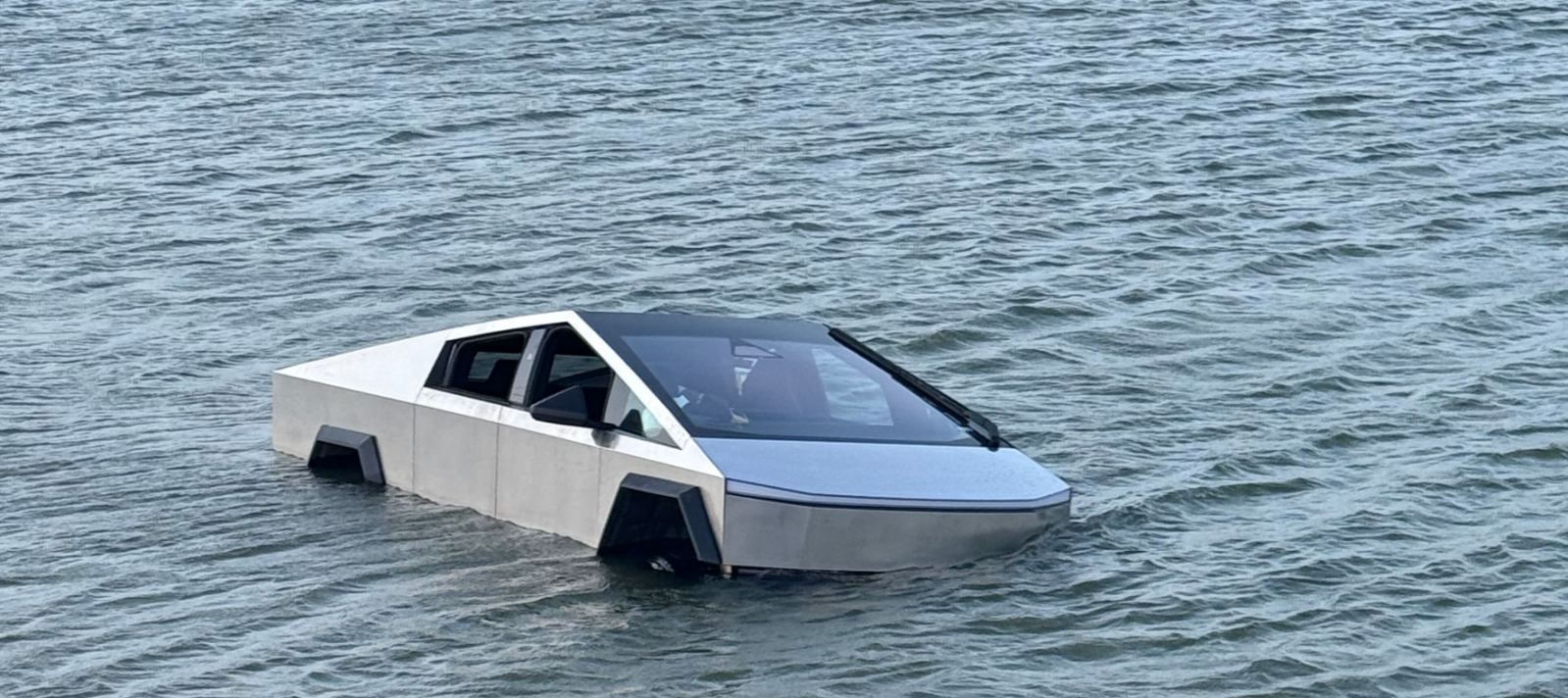
It was supposed to be the ultimate demonstration of futuristic automotive dominance. Instead, it became a wet, expensive nightmare ending in handcuffs. In a viral incident that has shocked both the tech and automotive worlds, a Tesla Cybertruck owner in Texas took Elon Musk’s ambitious claims of the vehicle’s amphibious capabilities to their literal extreme—and paid the ultimate price. The owner drove his high-end electric pickup straight into Grapevine Lake to test the much-hyped ‘Wade Mode,’ only for the vehicle to immediately die, leaving him stranded, embarrassed, and ultimately under arrest.
The Grapevine Lake Disaster: When Hype Meets Reality
The shocking incident unfolded at Grapevine Lake, a popular reservoir located in northern Texas. Seeking to capture the ultimate viral video and prove the ultimate superiority of Tesla’s stainless-steel behemoth, the driver bypassed warning signs and steered the heavy electric truck directly into the deep water. Observers watched in absolute disbelief as the futuristic vehicle slowly lost traction, floated briefly, and then completely shut down as water breached its sensitive electronic systems.
Instead of gliding effortlessly across the lake like a boat—a scenario famously teased by Tesla CEO Elon Musk on social media—the multi-ton truck became an expensive, immovable anchor. Local authorities were quickly dispatched to the scene. Not only did the owner have to watch his prized, six-figure electric vehicle get dragged out of the muddy depths by emergency towing services, but he was also placed under arrest by local police officers at the scene for reckless behavior and environmental violations.
The Myth of the Floating Cybertruck
This disaster is only the latest in a rapidly growing list of Cybertruck owners suffering catastrophic failures after taking marketing promises too seriously. For years, Elon Musk has claimed that the Cybertruck would be waterproof enough to serve briefly as a boat, suggesting it could cross calm lakes, rivers, and even seas. These sensational claims built an aura of invincibility around the truck, encouraging daring owners to push the limits of their vehicles in dangerous bodies of water.
However, the stark contrast between marketing hype and real-world engineering has never been clearer. While the Cybertruck features a specialized ‘Wade Mode’ that pressurizes the battery pack to prevent water ingress, the official Tesla owner’s manual explicitly warns against treating the vehicle as a boat. Water damage sustained during off-road or deep-water excursions is often not covered by warranty, leaving owners with repair bills totaling tens of thousands of dollars.
Why Wade Mode Fails and the Legal Consequences
Wade Mode is designed for crossing shallow streams and flooded streets, not navigating deep reservoirs. When submerged past its designated limits, the Cybertruck’s complex electrical architecture, exposed sensors, and high-voltage battery pack remain highly vulnerable to water damage. Once the water level exceeds the bumper, the risk of catastrophic short-circuits increases exponentially.
According to reports from Electrek, the legal fallout for the driver is just as severe as the mechanical damage. Local law enforcement officers emphasized that driving heavy motorized vehicles into public reservoirs poses immense environmental hazards, including potential battery acid leaks and toxic chemical contamination. Key takeaways from this incident include:
- Wade Mode Has Strict Limits: The feature is designed for temporary shallow crossings, not deep-water navigation or lake driving.
- Warranty Exclusions: Tesla’s warranty does not cover damages caused by flooding or extreme off-road water testing.
- Environmental Laws: Driving an electric vehicle into protected public waters can lead to severe criminal charges, hefty fines, and immediate arrest.
- Weight and Traction: The immense weight of the Cybertruck makes it highly susceptible to getting hopelessly stuck in soft lake mud.
As the video of the Grapevine Lake rescue continues to circulate online, it serves as a stark warning to all EV enthusiasts. Blindly trusting viral marketing claims over basic physics and local laws can lead to a ruined truck, a destroyed bank account, and a criminal record.