The Death of Lithium? China’s Gobi Desert Monster Unleashed
In a move that has sent shockwaves through the global renewable energy sector, China has just activated what can only be described as a sci-fi energy weapon in the middle of the barren Gobi Desert. Built by the state-owned giant China Three Gorges Corporation, this monstrous 1-gigawatt project is not just another solar farm. It is a revolutionary hybrid system that does what scientists have deemed practically impossible for decades: it generates massive amounts of clean solar energy long after the sun has completely vanished from the sky, and it does it without utilizing a single lithium-ion battery. This breakthrough threatens to completely upend the global battery supply chain and rewrite the rules of green energy forever.
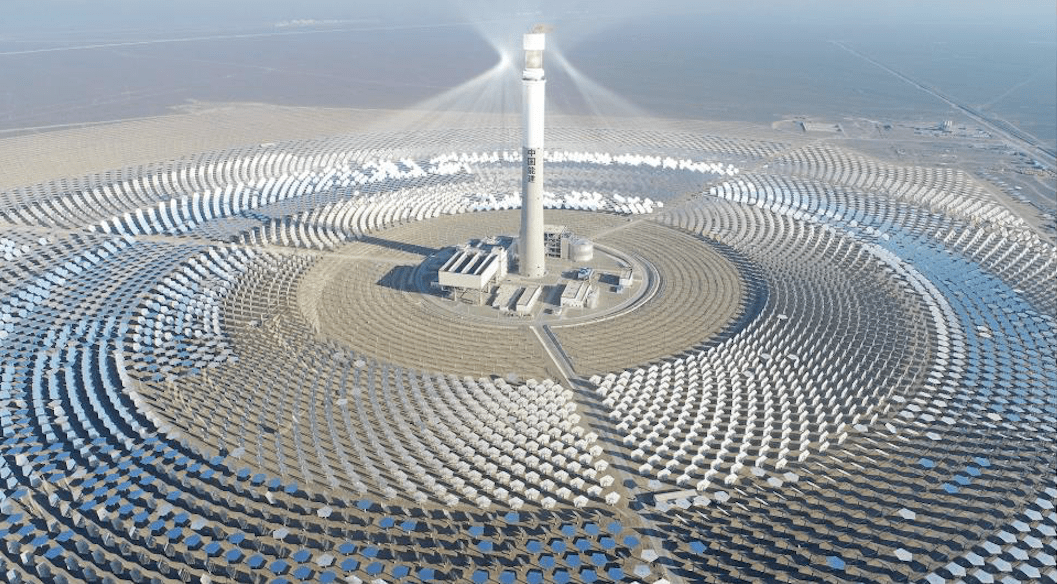
The Hami project, situated in the brutal terrain of Xinjiang, is the world’s largest solar PV-plus-concentrated-solar hybrid. Traditional solar energy has always suffered from one fatal flaw: the duck curve and the inescapable reality of nightfall. When the sun goes down, solar grids go dark, forcing operators to rely on expensive, environmentally taxing lithium battery storage systems or fossil fuel backups. But China’s new Gobi Desert behemoth has successfully bypassed the lithium monopoly altogether. By utilizing groundbreaking molten salt solar power technology, this facility can keep feeding clean power to the grid for up to eight hours after dark, transforming daytime sunshine into reliable, dispatchable midnight electricity.
How Molten Salt is Changing the Energy War Forever
How does this mind-boggling technology actually work? The secret lies in a dual-system architecture. While traditional photovoltaic (PV) panels harvest standard sunlight during peak hours, a massive array of mirrors, known as heliostats, tracks the sun and concentrates its blinding light onto a central thermal tower. According to reports by Electrek, this concentrated heat is transferred to a reservoir of molten salt, heating it to temperatures exceeding 500 degrees Celsius.
This superheated molten salt acts as an incredibly efficient thermal battery. When night falls, the stored heat is slowly released to generate high-pressure steam, which then spins massive turbines to produce electricity. The benefits of this system over lithium batteries are staggering:
- Zero degradation: Unlike lithium batteries that lose capacity over time, molten salt can be heated and cooled indefinitely without losing efficiency.
- Longer duration: Providing up to eight hours of continuous post-sunset power at an unprecedented utility scale.
- Environmental safety: No toxic mining practices or explosive thermal runaway hazards associated with lithium-ion chemicals.
- Economic superiority: Sourcing industrial salt is significantly cheaper and more geographically abundant than mining rare earth metals.
The Geopolitical Panic Over China’s Unlimited Clean Energy
As news of the Hami project’s successful trial operation spreads, Western energy analysts are scrambling to understand the immense geopolitical implications. For years, the United States and Europe have poured billions of dollars into securing fragile lithium supply chains to power the green transition. Now, China has demonstrated that the future of grid-scale energy storage might not require lithium at all. By mastering molten salt solar power at an unprecedented 1-gigawatt scale, Beijing is positioning itself to dominate the next phase of the global energy transition.
This massive project in Xinjiang represents a terrifying leap forward in energy independence. If China can successfully replicate this model across its vast, sun-drenched desert regions, it will create an unshakeable, self-sustaining energy grid that is completely immune to foreign resource blockades. The Gobi Desert, once thought to be a useless wasteland, is now the frontline of a global energy revolution that could leave the rest of the world in the dark.