The global electric vehicle race just took a massive, unexpected turn that could leave Tesla scrambling. For years, Elon Musk’s EV empire has enjoyed a comfortable lead thanks to its highly advanced lithium-ion battery technology. But a shocking new development from China has shattered the status quo. A commercial sodium-ion battery manufactured by Chinese firm Hina has been torn apart, and the results are sending shockwaves through the automotive world. Experts are already calling it the ultimate threat to Tesla’s dominance, and the implications are absolutely massive. If you thought Tesla was untouchable, think again.
The Shocking Truth Behind China’s New Tesla Killer
The transition to sustainable energy has triggered a ruthless technological gold rush, and the battery is the ultimate prize. For over a decade, lithium-ion has reigned supreme as the undisputed king of energy storage. However, lithium-ion has a dark side: it is expensive, environmentally damaging to mine, and controlled by highly volatile global supply chains. Enter the Hina sodium battery. Critics once laughed at the idea of using sodium—essentially table salt—to power the vehicles of the future, claiming it could never match the energy consistency of premium lithium cells. Those critics are now eating their words after a historic scientific revelation.
Inside the Teardown That Has Elon Musk Sweating
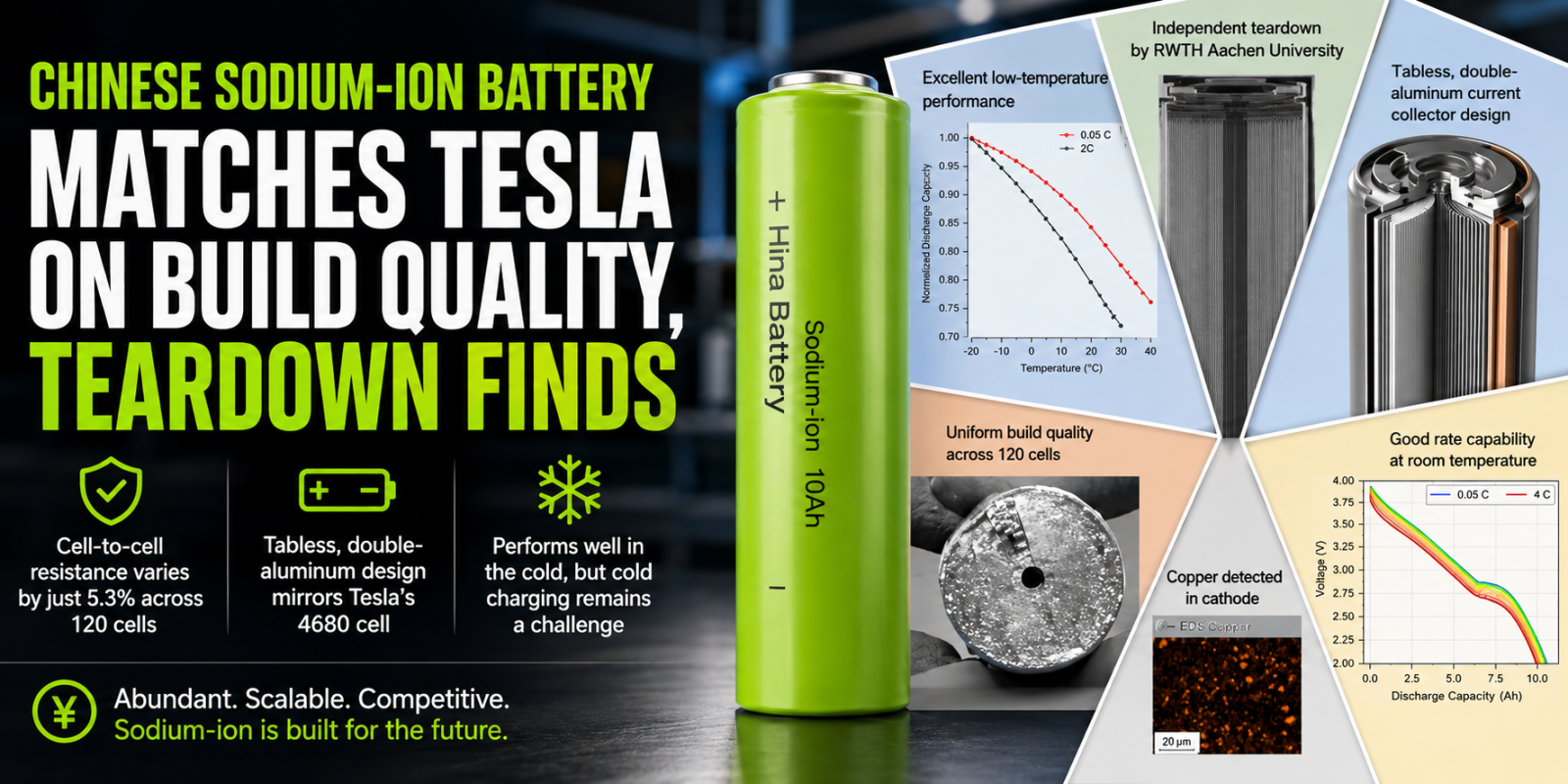
A groundbreaking independent teardown published in the prestigious Cell Reports Physical Science journal has exposed a terrifying reality for Western manufacturers. Researchers at Germany’s world-renowned RWTH Aachen University decided to put Hina’s commercial sodium-ion cells to the ultimate test. They took a digital scalpel to these cells to analyze their internal chemistry, design, and manufacturing consistency. What they discovered was nothing short of miraculous for China, and deeply alarming for Tesla.
The German researchers measured cell-to-cell resistance across 120 individual battery cells. Shockingly, the resistance varied by just 5.3%. In the world of battery manufacturing, this microscopic variance is a sign of an incredibly tight, ultra-high-precision mass-production process. This level of consistency directly rivals the absolute best lithium-ion cells currently on the market, including those manufactured by Tesla and Panasonic. For years, Western automakers comforted themselves with the belief that while Chinese batteries were cheap, they lacked the build quality and engineering excellence of Western-made batteries. This teardown completely demolishes that myth. Hina has proven that cheap, abundant sodium can be packaged with the same surgical precision as the world’s most expensive lithium batteries.
Why Sodium-Ion Could Wipe Out Lithium-Ion Forever
The threat to Tesla isn’t just about manufacturing quality—it is about raw economics and global dominance. Lithium-ion batteries rely on expensive, hard-to-source materials like lithium, cobalt, and nickel. These supply chains are plagued by geopolitical bottlenecks, soaring costs, and severe human rights concerns in mining regions. Sodium, on the other hand, is literally everywhere. It is derived from common salt, making it dirt cheap, environmentally friendlier, and virtually limitless. This means any country with access to the ocean can theoretically produce its own battery materials, breaking the chokehold on the global energy market.
Until now, the knock on sodium-ion batteries was their lower energy density and inferior build quality. But Hina’s latest breakthrough changes the entire playing field. If Chinese manufacturers can produce sodium-ion batteries with the same reliability and quality assurance as premium lithium cells, the cost of electric vehicles could plummet overnight. We are talking about high-performance, ultra-affordable EVs that could easily undercut Tesla’s cheapest planned models, flooding the market and democratizing electric mobility on a scale never before seen.
- Unprecedented Consistency: A tiny 5.3% variation in cell resistance proves Hina’s mass-production is world-class.
- The Cost Revolution: Sodium-ion eliminates the need for expensive lithium, drastically lowering production costs.
- Geopolitical Shift: China’s dominance in battery manufacturing is set to tighten even further, leaving Western automakers in the dust.
- Environmental Edge: Sodium extraction is far less destructive to the planet than intensive lithium mining.
As the energy transition accelerates, the battle for battery supremacy is heating up. Tesla has long been the undisputed king of the hill, but the rise of the Hina sodium battery represents a massive paradigm shift. With German researchers confirming that China’s cheap sodium technology is now structurally equal to the best lithium cells on Earth, the clock is ticking for Elon Musk. Will Tesla pivot to sodium, or will they be left behind in this high-voltage revolution? One thing is certain: the era of expensive lithium dominance is coming to an end, and China is holding all the cards.