
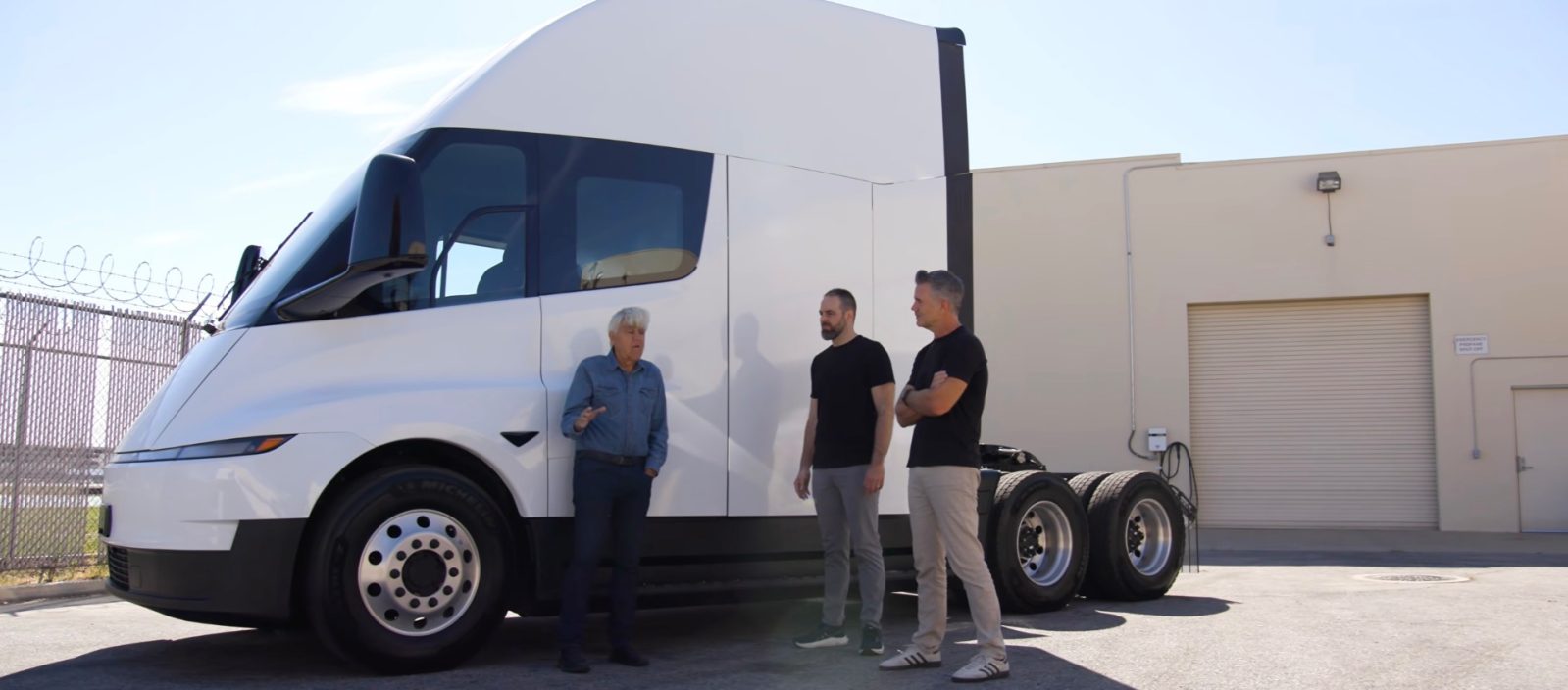
The 1,000-Pound Miracle: How Tesla Just Ended the Diesel Era
The automotive world is currently reeling from a bombshell revelation dropped in the latest episode of Jay Leno’s Garage. Tesla Semi program lead Dan Priestley sat down with the legendary host to provide an unprecedented look at the production-intent electric truck, and the details are nothing short of industry-shattering. For years, skeptics have claimed that electric heavy-duty trucks were a pipe dream, citing the massive weight of battery packs as a fatal flaw. However, Tesla has officially silenced the critics by revealing a staggering 1,000-pound weight reduction in their latest iteration, bringing the 500-mile range version to full payload parity with traditional diesel trucks.
This is the moment the logistics industry has been waiting for. By eliminating the weight penalty that has long haunted electric vehicles, Tesla has removed the final barrier to mass adoption. Fleet owners who were previously concerned that switching to electric would mean hauling less cargo can now breathe a sigh of relief. The engineering wizardry required to shave half a ton off a Class 8 vehicle while maintaining structural integrity and long-range battery capacity is a testament to Tesla’s lead in material science and vertical integration. This isn’t just a win for Tesla; it’s a death knell for the internal combustion engine in the long-haul sector. The weight savings are not merely an incremental improvement; they represent a fundamental shift in how electric powertrains are integrated into heavy-duty chassis.
Revolutionary Powertrain and Megawatt Charging Capabilities
During the extensive tour, Priestley dove deep into the technical specifications that make the Tesla Semi a mechanical masterpiece. The truck utilizes a sophisticated tri-motor powertrain architecture that leverages the same high-efficiency motor technology found in the Model S Plaid. This allows the Semi to maintain highway speeds even on steep grades, a feat that leaves struggling diesel engines in the rearview mirror. Furthermore, the introduction of the Megawatt Charging System (MCS) ensures that these behemoths spend more time on the road and less time at the plug. Tesla is effectively building a charging infrastructure that can deliver power at a scale previously thought impossible for mobile applications.
The sheer efficiency of the system is highlighted by its ability to manage thermal loads during rapid charging. Priestley explained that the production-intent model is built for durability, designed to withstand the brutal cycles of commercial hauling without the frequent maintenance intervals required by diesel particulate filters, complex transmissions, and oil systems. For more detailed technical analysis, industry experts often look to Electrek for the latest updates on EV infrastructure. The shift to electric isn’t just about saving the planet; it is about a superior machine providing a superior return on investment for every mile driven. The data shows that the operational costs of the Semi will be a fraction of those of a standard semi-truck, creating a competitive advantage that no logistics firm can afford to ignore.
Scaling to 50,000 Units: The Reno Mega-Factory Ramp
Perhaps the most sensational news from the interview is the scale of Tesla’s ambition. The dedicated Tesla Semi factory located just outside Reno, Nevada, is being engineered to reach a production capacity of 50,000 units per year. This volume is significant because it represents a major percentage of the total Class 8 truck market in North America. Tesla is not looking to be a niche player; they are aiming for total market dominance. By scaling production to this level, Tesla will benefit from massive economies of scale, further driving down the purchase price and making the Semi the obvious choice for any rational business owner. The facility is being built with high automation and cutting-edge battery manufacturing techniques to ensure that quality remains high even as volume increases.
- 1,000 lbs of weight savings for maximum cargo capacity.
- 500-mile range on a single charge at full gross vehicle weight.
- Full payload parity with traditional Class 8 diesel haulers.
- Annual production target of 50,000 units from the Reno facility.
- Tri-motor system providing unparalleled torque and efficiency.
- Advanced thermal management for consistent Megawatt charging.
In conclusion, the Tesla Semi has transitioned from a futuristic concept to an imminent reality that threatens to disrupt the multi-billion dollar trucking industry. With Jay Leno providing the platform and Dan Priestley providing the hard engineering facts, the world now knows that the electric revolution is not just coming—it is already here. The payload parity achievement is a landmark moment in transportation history, marking the official beginning of the end for diesel fuel as the standard for heavy hauling. As the Reno factory begins its massive ramp-up, the sight of silent, powerful Tesla Semis dominating the American highway system will soon become the new normal. The legacy manufacturers are officially on notice: adapt or become a footnote in automotive history.