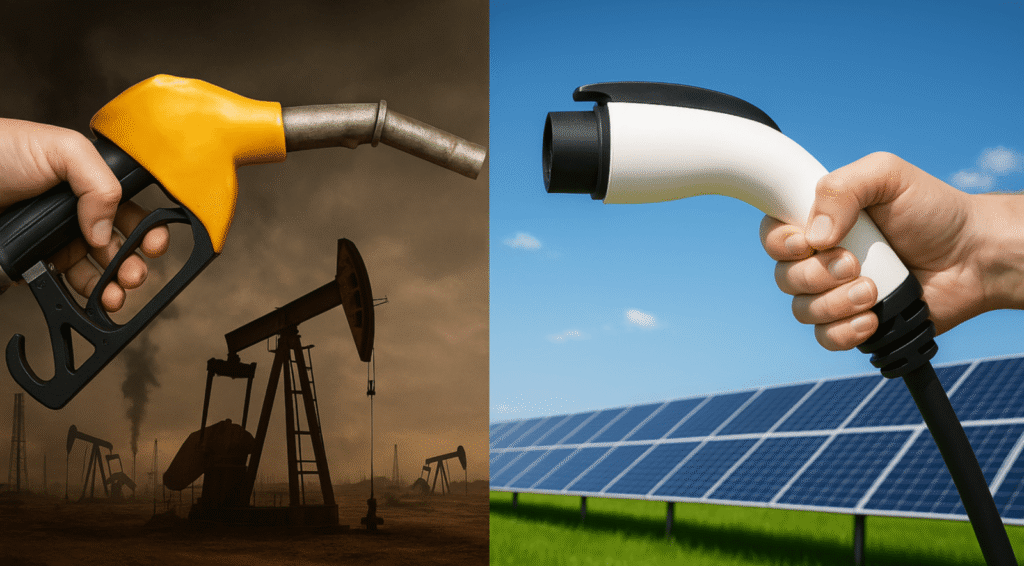

The global energy landscape is currently undergoing a transformation so violent and rapid that it is catching even the most seasoned market analysts off guard. For over a century, the internal combustion engine was the undisputed engine of the global economy, tethering the prosperity of nations to the volatility of crude oil. However, that era is coming to a screeching halt. Recent data from the 2025 fiscal year confirms a terrifying reality for fossil fuel giants: electric vehicles (EVs) are no longer just a luxury niche; they are a geopolitical wrecking ball that is systematically dismantling oil demand on a planetary scale.
The Great Displacement: How Big Oil Lost the War
The latest market intelligence suggests that the sheer volume of petroleum displaced by the global electric fleet has reached a staggering milestone. In 2025, the demand wiped out by the adoption of EVs was equivalent to roughly 70% of the total annual oil exports of Iran, one of the world’s most significant producers. This isn’t just a minor dent in the balance sheet; it is a structural collapse of demand that is beginning to leave the global oil market in a state of permanent oversupply. As manufacturers like Tesla, BYD, and Ford scale their production to millions of units, the ‘peak oil’ narrative has shifted from a distant prophecy to a present-day crisis for the petroleum industry.
This displacement is driven by the unparalleled efficiency of the electric powertrain. While internal combustion engines waste nearly 80% of their energy as heat, electric motors convert over 85% of their energy into direct motion. This efficiency gap, combined with the plummeting costs of renewable energy, has created an economic vacuum that is sucking the lifeblood out of traditional fuel markets. The transition is being led by heavy hitters in the industry, and detailed reporting on these shifts can be found at Electrek, where the transition to sustainable energy is documented daily.
The Shocking Numbers: 70% of Iran’s Exports Vanished
To put the ‘70% of Iran’s exports’ figure into perspective, we must look at the sheer volume of barrels involved. We are talking about millions of barrels of oil per day that are simply no longer needed. This phenomenon is largely attributed to the massive uptick in EV adoption in China and Europe, where aggressive government mandates and superior charging infrastructure have made petrol-powered cars nearly obsolete for new buyers. In the United States, the success of the Tesla Model Y and the introduction of affordable electric trucks have accelerated this trend, pushing the displacement numbers into the stratosphere.
As demand falters, the geopolitical leverage held by oil-producing nations is evaporating. Historically, a disruption in Middle Eastern supply would send global shockwaves through the economy, leading to skyrocketing gas prices and inflation. But in 2025, the ‘EV buffer’ has become so significant that the market can absorb supply shocks that would have previously caused a global recession. The power is shifting from those who own the wells to those who own the mines and the battery patents.
The Tipping Point: Why 2025 Changed Everything
What makes 2025 a pivotal year in human history is the convergence of price parity and infrastructure maturity. For years, the primary argument against EVs was their high upfront cost and the lack of reliable charging. However, by early 2025, battery prices hit the critical threshold of $100 per kilowatt-hour, making electric cars cheaper to manufacture than their gasoline counterparts. Simultaneously, the global charging network reached a density that eliminated ‘range anxiety’ for the average consumer.
- Massive investment in solid-state battery technology.
- The rollout of 500kW ultra-fast charging stations globally.
- Secondary markets for used EVs finally reaching maturity.
- Government bans on internal combustion engines entering city centers.
The result is a feedback loop that is impossible to stop. As more people switch to electric, the cost of maintaining gas station infrastructure increases, leading to more closures and making gasoline even more inconvenient for the remaining ICE drivers. We are witnessing the final gasps of a dying industry, and the numbers don’t lie: the electric revolution has won, and the oil age is officially on life support.