
In a significant development for Tesla’s future mobility plans, recent drone footage from Giga Texas has provided compelling evidence that the highly anticipated Cybercab robotaxi units are undergoing rigorous crash testing. Tesla, known for its vertical integration and in-house engineering, operates dedicated Crash Labs at its Giga Texas and Fremont facilities, allowing for comprehensive safety evaluations of its evolving vehicle platforms.
Cybercab Safety Under the Microscope
The latest insights come from Tesla YouTuber Joe Tegtmeyer, who has been meticulously tracking activities at the Giga Texas plant. Tegtmeyer’s drone coverage has captured multiple Cybercab robotaxi prototypes that have been placed in a storage lot, clearly marked as having completed crash test procedures. This visual confirmation follows Tegtmeyer’s earlier reports suggesting that such testing was underway, providing concrete proof of Tesla’s commitment to ensuring the safety and structural integrity of its autonomous taxi fleet.
One particularly telling prototype, identified by the marking “PSFTY-7689,” shows signs of a side-impact collision. The damage, while evident on the doors and windshield, highlights the resilience of the Cybercab’s steel side frame and rear casting assembly. Even after a forceful impact, the core passenger compartment appears to have remained largely intact, suggesting a robust design focused on occupant protection in real-world accident scenarios, such as a t-bone collision. This level of detail in testing is crucial as Tesla aims for a Q2 2026 production start for the Cybercab.
Another Cybercab prototype, partially covered, displays markings on its hood, indicating it has been subjected to frontal impact crash tests. These tests are vital for any vehicle, especially one designed for autonomous operation where external factors and potential unpredictable events must be accounted for. Tesla vehicles consistently achieve top safety ratings, with the Cybertruck earning accolades from both NHTSA and IIHS in 2025. The Cybercab’s testing regimen suggests a continuation of this safety-first philosophy.
Giga Texas: A Hub for Innovation and Production
Beyond the crash-tested Cybercabs, Giga Texas is also becoming a visible hub for the manufacturing of Cybercab components. Drone footage has revealed piles of unibody Giga Castings specifically for the Cybercab, signaling a ramp-up in production preparation. This aligns with Tesla’s strategy of leveraging its advanced casting technology to streamline manufacturing processes, reduce weight, and enhance structural rigidity. The presence of these castings strongly indicates that Tesla is not only testing but also scaling up the production capabilities for its robotaxi platform.
Cortex 2: Powering Tesla’s AI Future
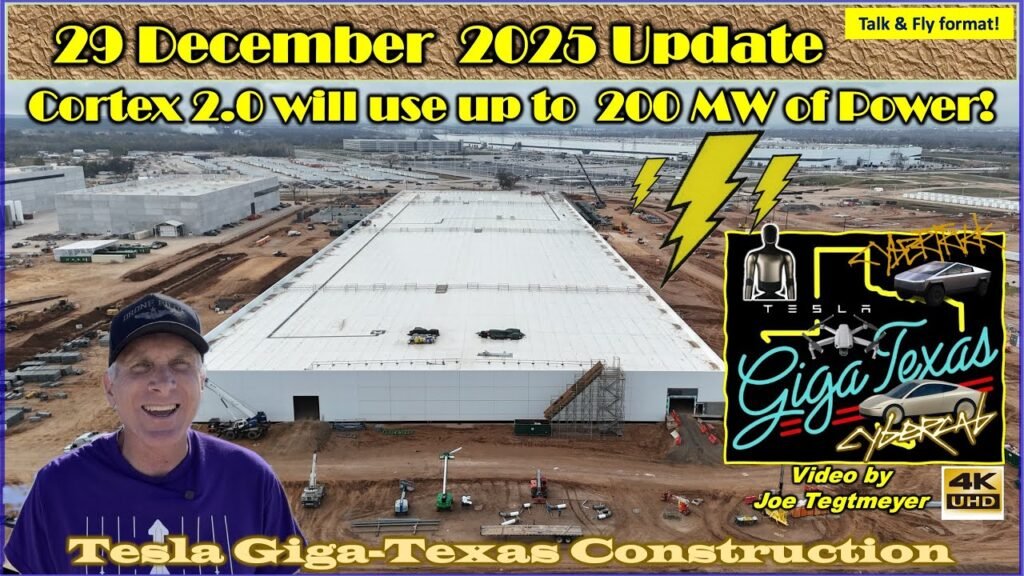
The drone footage also offered an update on the construction of the Cortex 2 AI Supercluster at Giga Texas. This massive data center is set to significantly expand Tesla’s artificial intelligence processing capabilities, complementing the already operational Cortex 1. These superclusters are essential for training the complex neural networks required for Tesla’s Full Self-Driving (FSD) system and the AI vision systems for the Optimus humanoid robot. The sheer scale of these facilities necessitates substantial infrastructure, including advanced cooling and fire-mitigation systems.
Permits filed for Cortex 2 indicate an immense power requirement, projected up to 200 MW. This energy demand will be met by a sophisticated network of transformers and a large-scale chiller system, both of which are currently under construction. The facility’s West Hall, designed to house the bulk of the servers, will be protected by state-of-the-art systems, including the NPVEC fire suppression system (similar to HALON, tailored for computer systems) and a VESDA (Very Early Smoke Detection Alarm) system for rapid fault detection. The development of Cortex 2 underscores Tesla’s deep investment in AI infrastructure, crucial for advancing autonomous driving and robotics technology.
The ongoing crash testing of the Cybercab at Giga Texas, coupled with the expansion of its AI data center infrastructure, paints a clear picture of Tesla’s forward momentum. These developments are not just about manufacturing vehicles; they represent Tesla’s holistic approach to building a future of autonomous mobility and advanced robotics, underpinned by cutting-edge safety standards and powerful AI processing capabilities.
Check pricing on Amazon: View on Amazon