Elon Musk Drops Insane Cybercab Bombshell: Space Internet Is Built-In!
In a jaw-dropping move that has sent shockwaves through both the automotive and aerospace industries, Elon Musk has officially unveiled a secret feature tucked inside Tesla’s highly anticipated Cybercab. The futuristic, steering-wheel-less robotaxi isn’t just relying on standard terrestrial cellular networks to navigate city streets—it is now directly hooked up to SpaceX’s massive constellation of low-Earth orbit satellites!
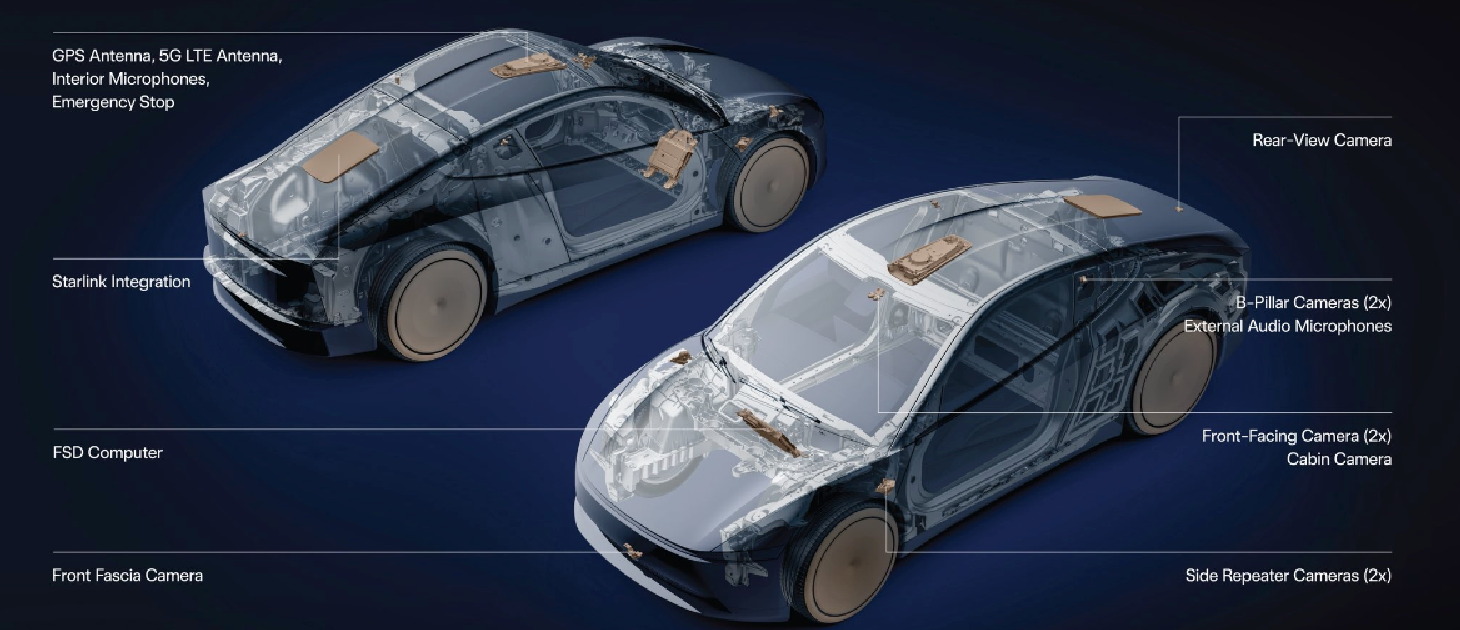
A series of mind-bending posts released on social media revealed a dramatic cutaway diagram showcasing a custom-engineered Starlink satellite antenna embedded right into the glass and steel roof of the Cybercab. While fans and tech enthusiasts are hyperventilating over this unprecedented synergy between Musk’s high-tech empires, industry analysts are left asking one terrifying question: Why on Earth does a localized autonomous car need a high-speed internet link to outer space?
Why Does an Autonomous Car Need Signals From Space?
The sudden integration of Starlink into the Cybercab raises massive questions about the future of autonomous vehicles and surveillance technology. Officially, autonomous vehicles rely primarily on onboard compute power to process camera feeds, make split-second driving decisions, and safely deliver passengers to their destinations. In theory, a robotaxi should be able to navigate without any active internet connection at all.
However, analysts suspect that Musk’s vision for global automated transportation requires bulletproof connectivity that legacy cellular carriers simply cannot guarantee. Here is why this outer-space link might change everything:
- Zero Dead Zones: Whether the Cybercab is cruising through dense urban skyscrapers or remote desert highways, satellite internet ensures the vehicle never loses communication with mission control.
- Instant Fleet Updates: Real-time video telemetry could be beamed back to Tesla’s neural network training centers instantaneously, drastically accelerating self-driving AI improvements.
- Remote Intervention: If a Cybercab encounters a bizarre hazard or natural disaster, human teleoperators could take control from anywhere on the planet via high-bandwidth satellite relay.
- Unmatched Passenger Entertainment: High-speed Wi-Fi will allow passengers to stream 4K movies, play cloud-based video games, or host video calls seamlessly while the car drives itself.
The Secret Tech Hidden Inside the Roof
The engineering required to flush-mount a high-performance satellite dish inside the roof panel of a production electric vehicle is nothing short of science fiction. Standard Starlink dishes require significant power and precise orientation, but the Cybercab utilizes a specialized phased-array antenna capable of dynamically locking onto satellites whipping across the sky at thousands of miles per hour—all while the vehicle speeds down the highway at 70 mph.
According to updates shared regarding Tesla driverless innovations, this hardware integration represents the ultimate crossover between SpaceX and Tesla. By controlling both the hardware in space and the software on the ground, Musk is building a hyper-connected fleet that traditional automakers like Ford, GM, or even Waymo simply cannot replicate.
Could this move signal a world where your taxi ride isn’t just self-driving, but directly linked to an orbital satellite grid? The implications for privacy, security, and global transportation are staggering. As Tesla prepares to roll out the Cybercab to mass production, one thing is abundantly clear: Elon Musk is playing a completely different game than the rest of the auto industry, and the sky is no longer the limit!