The era of unregulated speed on California’s streets is coming to a screeching halt as Amazon, the world’s largest online retailer, officially announced a sweeping ban on the sale of high-speed electric motorbikes within the state. This move marks a historic turning point in the battle over urban mobility, targeting vehicles that have long exploited legal loopholes to masquerade as standard electric bicycles while packing the power of high-performance motorcycles. For years, the ‘hooligan bike’ culture has flourished, but a massive investigation into safety and compliance has finally forced the retail giant’s hand, signaling a new chapter in the regulation of electric vehicles.
The Great E-Bike Crackdown: Amazon Strikes Back
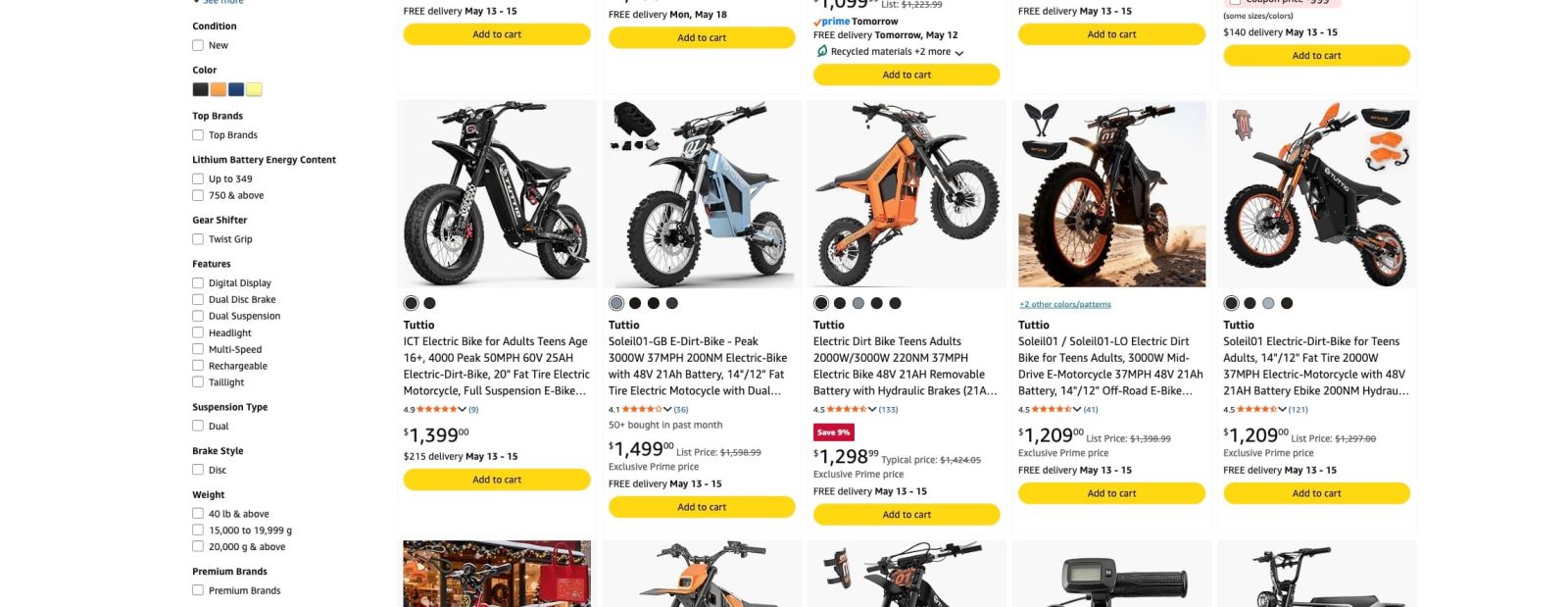
Amazon’s decision to restrict these sales is not merely a minor policy adjustment; it is a calculated response to a growing public safety crisis. In California, e-bikes are strictly categorized into three distinct classes to ensure rider and pedestrian safety. Class 1 and Class 2 bikes are limited to 20 miles per hour, while Class 3 bikes—the fastest legal e-bikes—can reach up to 28 miles per hour with pedal assistance. However, the market has been flooded with machines capable of hitting speeds between 40 and 60 miles per hour. These vehicles, often marketed with ‘off-road’ disclaimers, were being used on public roads, sidewalks, and bike paths by riders who were often unlicensed and uninsured.
The crackdown follows an intense more detailed investigation that highlighted how easily these high-powered machines were reaching consumers. Many of these bikes lack the fundamental safety features required for motorbikes, such as high-grade hydraulic brakes, turn signals, and Department of Transportation (DOT) approved lighting. By pulling these items from their California storefront, Amazon is effectively cutting off the primary distribution channel for dozens of manufacturers who have historically ignored state laws in favor of viral marketing and high-speed thrills.
Redefining the Road: Why California is Target Number One
California has always been at the forefront of the green transportation revolution, but its infrastructure has struggled to keep pace with the rapid evolution of EV technology. Local law enforcement agencies in cities like Los Angeles and San Francisco have reported a staggering increase in accidents involving high-speed e-bikes. Because these vehicles often look like standard bicycles, they are difficult to monitor and regulate. The lack of registration and license plates means that when an accident occurs, identifying the rider is nearly impossible. Amazon’s move is seen as a necessary intervention to protect the integrity of the e-bike as a legitimate commuting tool rather than a dangerous toy.
The Fuzzy Line Between Commuter Tools and Lethal Machines
The technical distinction between an e-bike and a motorcycle is legally defined by motor wattage and top speed. Most standard e-bikes use 250W to 750W motors. In contrast, many of the ‘hooligan’ bikes banned by Amazon utilize 3000W to 5000W motors, allowing them to keep pace with highway traffic. This ‘fuzzy line’ has created a nightmare for regulators. When a 150-pound bike travels at 50 miles per hour on a pedestrian path, the kinetic energy involved is comparable to a small car, making any collision potentially fatal. Safety advocates have long argued that these machines should be registered as motorcycles, requiring a M1 license and proper insurance coverage.
The impact of Amazon’s decision will likely ripple across the entire e-commerce landscape. Industry analysts predict that other major retailers like Walmart and eBay will soon follow suit to avoid potential liability and regulatory fines. This shift could force manufacturers to rethink their designs, potentially leading to a new generation of ‘smart’ e-bikes that use GPS-based geofencing to automatically limit speeds in residential zones or on bike paths. While the ban may frustrate speed enthusiasts, it represents a vital step toward a more organized and safer urban environment. As the ‘Wild West’ era of electric mobility ends, the focus shifts back to sustainable, safe, and legal transportation for everyone.
- Strict enforcement of Class 1, 2, and 3 e-bike categories.
- Increased liability for retailers selling non-compliant motor vehicles.
- Potential for mandatory registration of high-wattage electric bikes.
- A shift toward safety-first engineering in the micromobility sector.