
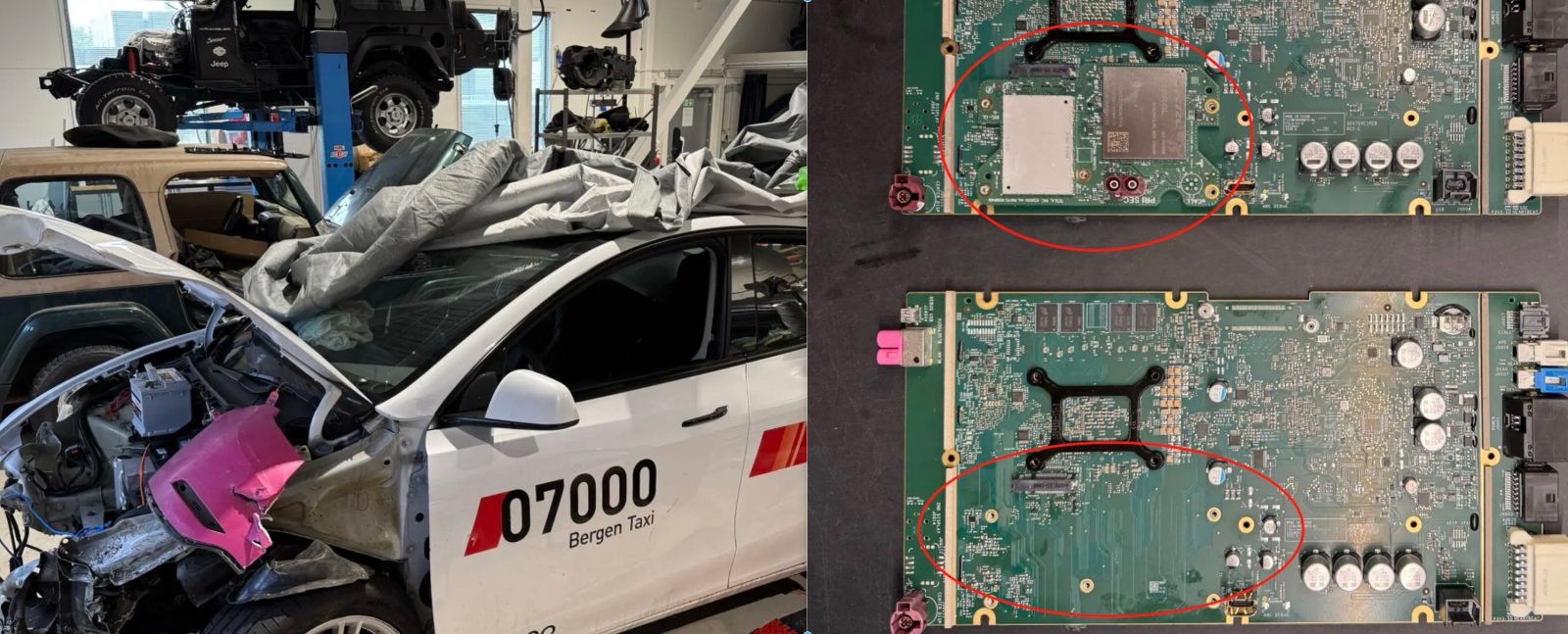
In a plot twist that seems ripped straight from a high-stakes corporate espionage thriller, a critical piece of evidence has vanished from a wrecked Tesla Model Y in Bergen, Norway. The vehicle, which was involved in a terrifying high-speed accident, is now at the center of a burgeoning scandal involving missing hardware, potential data tampering, and a search for answers that has gone cold. Investigators were shocked to discover that the network card—the literal ‘brain’ responsible for storing and transmitting crash data—was physically removed from the car before it could be properly analyzed.
The Mystery of the Missing Tesla Network Card
The incident in question dates back to a 2023 crash that shocked the local community in Bergen. A Tesla Model Y, operating as a taxi, suddenly accelerated to speeds of 90 km/h in a residential area. According to eyewitnesses and preliminary reports, the vehicle launched into the air, performing a death-defying arc before slamming violently into a kiosk. The driver survived, but the questions regarding why the car behaved in such an erratic manner have only intensified as the investigation hit a digital dead end. The disappearance of the network card is not just a minor loss; it is the loss of the primary witness in this case.
This network card is the gateway to Tesla’s internal telemetry. In modern electric vehicles, every steering input, brake application, and pedal position is recorded with millisecond precision. This data is typically stored locally before being uploaded to the cloud. By removing the card, the perpetrator has effectively blinded the investigators, making it nearly impossible to determine if the crash was caused by driver error or a catastrophic software glitch in Tesla’s Autopilot or Full Self-Driving suites. The audacity of the theft suggests that whoever took the card knew exactly what they were looking for and understood its immense value in a court of law.
A Violent Impact and a Vanishing Evidence Trail
The 2023 crash was nothing short of cinematic. The vehicle reached nearly double the speed limit before it took flight. The force of the impact with the kiosk was enough to total the vehicle and cause significant structural damage to the surrounding area. Initially, the focus was on the driver’s actions, but as rumors of ‘unintended acceleration’ began to circulate, the technical data became the most sought-after resource for both the defense and the prosecution. Without the physical card, authorities are forced to rely on whatever fragments of data Tesla might have received over the cellular network before the connection was severed by the impact.
Norwegian authorities are now faced with a secondary criminal investigation: who had access to the impound lot? The breach of security at the storage facility raises uncomfortable questions about the chain of custody for evidence in high-profile EV accidents. If a critical component can be snatched from a police-secured vehicle, the integrity of the entire judicial process is at risk. This theft has sparked theories ranging from corporate cover-ups to desperate attempts by third parties to hide evidence of negligence. As reported by Electrek, the missing hardware has left a massive hole in the technical reconstruction of the accident.
Why This Data Chip is the Smoking Gun
To understand why someone would risk a felony to steal a small circuit board, one must understand the level of detail stored on Tesla’s internal systems. Unlike traditional vehicles, Tesla’s EDR (Event Data Recorder) captures a massive array of variables. The stolen network card likely contained:
- Precise logs of the accelerator pedal position at the moment of launch.
- Brake pressure data that could prove if the driver tried to stop the car.
- High-resolution logs of the Autopilot system’s environment perception.
- Communication logs between the car and Tesla’s central servers.
The loss of this data is a major setback for EV safety transparency. If there was a flaw in the vehicle’s logic, it may now never be proven. Conversely, if the driver was at fault, the evidence needed to secure a conviction has been compromised. The tech community is now calling for more robust physical security for vehicle computers following accidents. As cars become more like ‘computers on wheels,’ the theft of a hard drive becomes as significant as the theft of a murder weapon. For now, the Bergen kiosk crash remains a digital mystery, a haunting reminder that in the age of AI and big data, the most important truths can be as fragile as a single missing chip.